ISSN (Print): 2945-381X
ISSN (Online): 3082-5563
ISSN (Online): 3082-5563
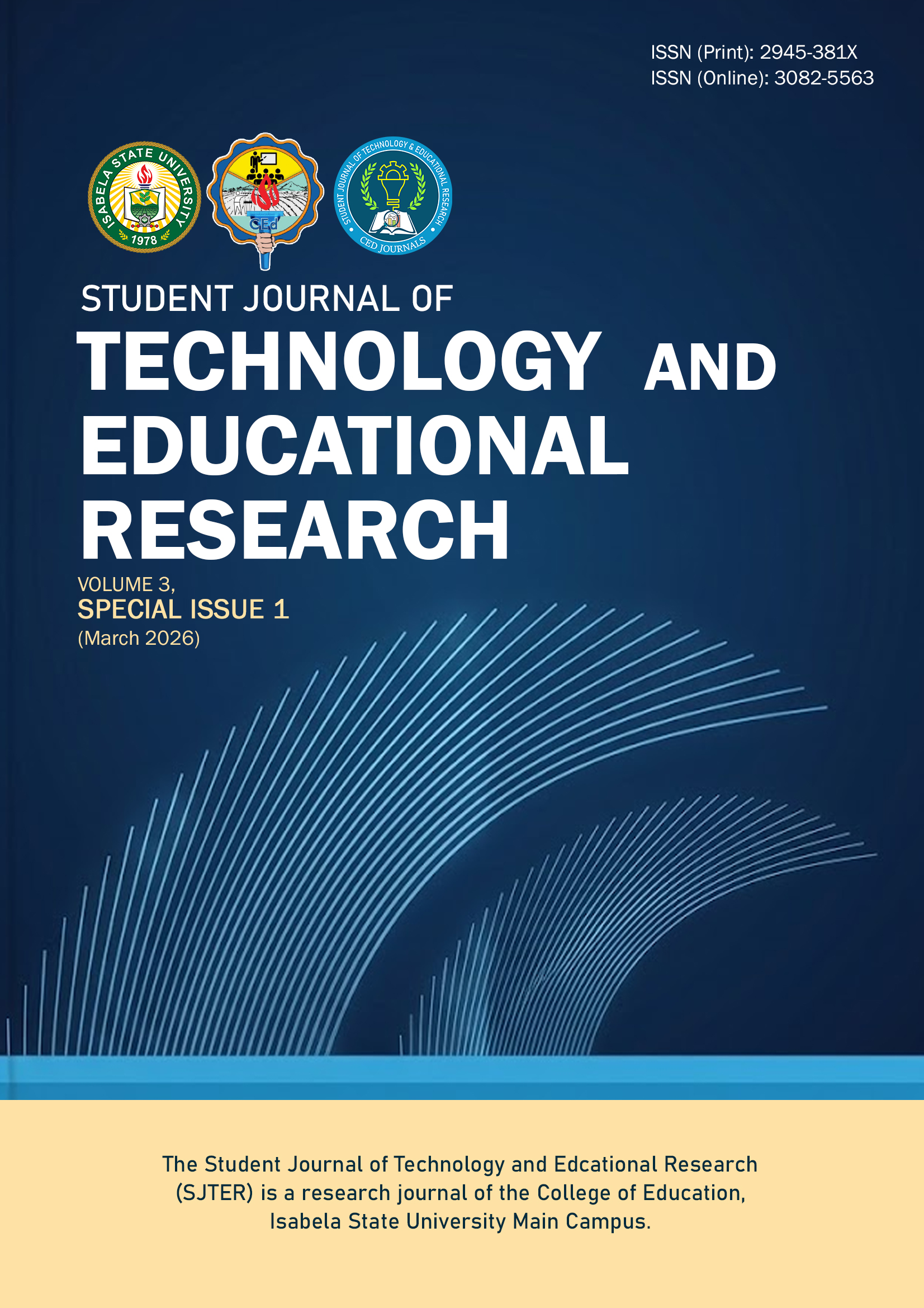
Editor's Note
This Special Issue of the Student Journal of Technology and Educational Research is a collective work of different student-researchers inside and outside the University. It brings together studies that show the ideas, efforts, and experiences of students in the fields of technology and education. Each article presents useful findings and insights that help us better understand current issues and practices in teaching and learning.
This issue includes studies on the use of artificial intelligence in reading and writing tasks, as well as its role in higher education. It also presents research on physical literacy among physical education teachers and how training affects teaching in mathematics. In addition, several papers focus on mathematics learning, including students’ self-confidence, reading comprehension, symbolic translation skills, and mathematical fluency. These topics show how both technology and basic learning skills are important in improving student performance.
We would like to thank all the authors for their hard work and dedication in completing their studies. We also thank the reviewers and members of the editorial team for their time and effort in reviewing and preparing the manuscripts for publication. We hope that this Special Issue will inform, guide, and encourage other students to take part in research and share their own work.
-The Editor-in-Chief
Volume 2, Issue 1 (2025) of SJTER presents a diverse mix of empirical studies and applied‑research articles that reflect contemporary concerns in education, technology, and vocational/training contexts. The issue includes investigations into topics such as students’ language learning strategies and motivation, leadership qualities among student‑leaders, differences in classroom engagement when using traditional vs. holographic display‑based settings, and the use of generative AI tools to support academic writing.
It also features applied‑research on vocational and technical training, analyses of students’ academic choices, and studies assessing reading skills, financial literacy among teachers, and employability readiness from senior‑high school work‑immersion programs.
The Editorial Board of the Student Journal of Technology and Educational Research (SJTER) is pleased to present Volume 3, Issue 1 (2026) of the journal, which showcases a collection of scholarly works produced by student researchers and educators from various academic institutions. These research outputs reflect the growing commitment of emerging scholars to addressing contemporary educational challenges through rigorous and meaningful inquiry.
The articles featured in this issue highlight the evolving landscape of education, where technological innovation, evidence-based pedagogy, and learner-centered practices converge to improve teaching and learning outcomes. Several studies explore the integration of artificial intelligence in education, particularly in reading-to-writing instruction, which underscore both the opportunities and responsibilities that accompany the increasing use of AI in academic settings. Other contributions examine professional development among teachers, physical literacy in physical education, and key determinants of mathematics learning, including self-confidence, reading comprehension, symbolic translation, and mathematical fluency. Collectively, these studies demonstrate how diverse educational factors interact to influence learner achievement and instructional effectiveness.
This issue also reflects the journal’s continuing mission to provide an inclusive platform for student researchers to disseminate original and relevant research. The breadth of topics represented affirms the importance of interdisciplinary inquiry and the valuable contributions that student-led investigations make to educational scholarship and practice.
The Editorial Board extends its sincere appreciation to all authors for entrusting SJTER with their scholarly work and for their dedication throughout the publication process. We likewise express our gratitude to our peer reviewers, whose expertise, professionalism, and commitment have ensured the quality and integrity of every published manuscript.
We hope that the research presented in this issue will inspire further inquiry, encourage evidence-informed educational practices, and motivate more students and educators to engage in research that contributes to the continuous advancement of education and technology. As the field continues to evolve, we remain committed to building a vibrant community of emerging researchers whose works contribute meaningfully in schools, communities, and society.
The Editor-in-Chief
Volume 1, Issue 1 (2022) of SJTER showcases a collection of student-led research articles focused on education and technology. This inaugural issue features studies on online learning, academic performance, study habits, and innovative applications of local resources in educational contexts, which reflects the diverse interests and academic initiatives of education students at Isabela State University.
The issue highlights the journal’s commitment to promoting evidence-based research and practical solutions in teacher education, combining empirical studies with creative projects such as eco-packaging, nutritive candies, and food innovations, demonstrating a balance between scholarly inquiry and community-relevant innovation.
It is with great pleasure that I present this issue of the Student Journal of Technology and Educational Research (SJTER). This journal represents our continuing commitment to providing a platform for student researchers who share innovative ideas, evidence-based practices, and meaningful insights in the field of technology and education.
Each article in this issue has undergone a careful peer review process to ensure the quality, relevance, and integrity of the research.
As the Editor-in-Chief of this journal, I am deeply grateful to the authors who entrusted us with their scholarly contributions. I also extend my sincere appreciation to our peer reviewers for their professionalism and commitment to maintaining the standards of SJTER.
This issue symbolizes more than just a collection of articles. It is a testament to the growing community of student researchers who continue to be curious and deeply engaged in understanding the world around them.
I invite all readers to explore the works presented in this issue and to take part in the meaningful discussions that arise from them. Thank you for your continued support and for joining us in advancing research at the vibrant intersection of technology and education.
RANDY P. ACOBAMR. RANDY P. ACOBA
Isabela State University, Philippines
Editor-in-Chief
DR. DENMARK L. YONSON
Philippine Normal University, Philippines
Associate Editor, Educational Research
DR. ADRIAN LAWRENCE P. CARVAJAL
Teacher Education Council, Department of Education, Philippines
Associate Editor, Educational Research
DR. JAY-AR G. BALAUAG
Philippine Normal University, Philippines
Associate Editor, Technology Research
DR. ALEIN B. NAVARES
Cebu Institute of Technology University, Philippines
Associate Editor, Technology Research
DR. JOSHUA T. SORIANO
Technological University of the Philippines
DR. CHRISTOPHER DC. FRANCISCO
Department of Education, Philippines
DR. REGIE M. BANGOY
West Visayas State University
PROF. VIVIEN R. MAURICIO
Philippine Normal University, Philippines
DR. CHRISTIAN T. GALGAO
Bohol Island State University-Bilar Campus, Philippines
DR. DAYANARA P. BESA
Sultan Kudarat State University, Philippines
DR. JOHN ROBBY O. ROBINOS
University of Perpetual Help System DALTA, Philippines
PROF. RAVEENTHIRAN VIVEKANANTHARASA
The Open University of Sri Lanka, Colombo, Sri Lanka
PROF. FADHILAH B. JAMALUDDIN
Faculty of Education, Universiti Malaya, Kuala Lumpur, Malaysia
DR. THITI JANTAKUN
Roi Et Rajabhat University, Thailand
DR. PAGON GATCHALEE
Chiang Mai University, Thailand
DR. RONIEL S. FORTUNA
Ritsumeikan Asia Pacific University, Japan
DR. MARINEL P. DAYAWON
Dean, College of Education, Isabela State University Main Campus
DR. MA. THERESA L. EUSTAQUIO
Campus Research Director, Isabela State University Main Campus
DR. ARTEMIO A. MARTIN, JR., Ph.D.
Executive Officer, Isabela State University Main Campus
Enter your email to receive our announcements, calls for papers, and new publications.